
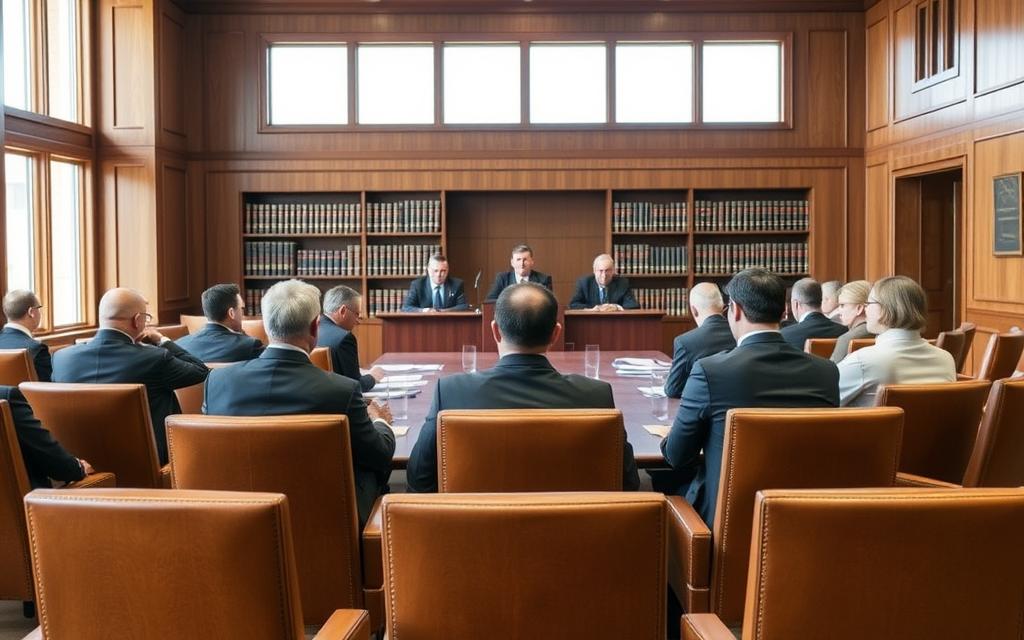
Did you know over 60 million Americans are in arbitration agreements? These are in their work and consumer deals. Arbitration is a big way to solve disputes in the U.S., instead of going to court.
An arbitration hearing is a private way to solve conflicts. It’s not like a court trial. A neutral third-party arbitrator listens to both sides. Then, they make a final decision.
The arbitration process is quick and easy. Businesses, consumers, and workers use it to solve problems fast and cheap. It’s better than long court cases because it’s faster.
Key Takeaways
- Arbitration is a private alternative to court litigation
- A neutral arbitrator makes the final binding decision
- The process is typically faster and less expensive than traditional court trials
- Many employment and consumer contracts include mandatory arbitration clauses
- Arbitration offers more flexibility than standard court procedures
Introduction to Arbitration Hearings
Arbitration is a smart choice instead of going to court. It’s a quick way to solve problems. It helps both people and companies fix legal issues fast.
In an arbitration, a neutral person listens to both sides. They look at the evidence and hear what each party says. It’s a way to solve disputes that’s less formal than a trial.
Definition of Arbitration
An arbitration is a private way to settle disputes. Arbitration rules guide it. Here’s what makes it special:
- A neutral arbitrator oversees the whole thing
- Both sides share evidence and arguments
- The arbitrator decides, and it’s usually final
- It’s faster and cheaper than going to court
Importance of Arbitration in Dispute Resolution
The arbitrator role is key to fair and quick dispute solving. Arbitration is getting more popular. It has big benefits:
- It keeps things private
- It’s flexible with schedules
- Arbitrators are experts
- It’s simpler than court
Arbitration is a smart way to solve problems. It’s a fast and affordable option. It’s great for businesses and people who want quick solutions.
The Arbitration Process Explained
Understanding the Arbitration Procedure Guide is key. It shows the steps of the Arbitration Hearing Process. This guide will explain the main stages of dispute resolution.
The Arbitration Hearing Timeline has five main stages. Each stage is designed for fair and quick conflict resolution:
- Agreement to Arbitrate: Parties agree to solve disputes outside of court.
- Arbitrator Selection: Neutral third-party professionals are chosen to oversee the case.
- Pre-Arbitration Preparation: Gathering documents and evidence happens here.
- Arbitration Hearing: Arguments and evidence are presented.
- Final Decision: A binding arbitration award is given.
Key Steps in the Arbitration Process
Each stage of the Arbitration Hearing Process is important. Parties must know their roles and prepare well. The first agreement sets the stage, and choosing the right arbitrator is key for a fair outcome.
Understanding the Arbitration Hearing Timeline
Arbitration can take weeks to months, based on the case. Simple disputes usually end in 3-6 months. This is much faster than regular court cases.
Arbitration is flexible. It lets parties tailor the process. This makes it a good choice for solving disputes quickly and privately.
Types of Arbitration
Arbitration is a key way to solve disputes in many areas. It has different methods for each situation, making it efficient for solving problems.
Knowing the types of arbitration helps pick the right one for each case.
Commercial Arbitration
Commercial arbitration deals with business disputes. In business, arbitration covers:
- Contract disagreements
- Intellectual property conflicts
- Business partnership disputes
- International trade arguments
Consumer Arbitration
Consumer arbitration helps with issues between people and companies. It includes product liability claims, service disputes, and warranty issues.
Labor Arbitration
Labor arbitration handles work-related problems. It helps solve disagreements between employers and employees.
- Wage disputes
- Termination challenges
- Workplace discrimination claims
- Contract interpretation
In Charleston, South Carolina, arbitration is a top choice for solving legal problems. It shows how useful this method is.
Legal Framework Governing Arbitration
The rules of arbitration in the United States are complex. It’s important to know these rules if you’re in an arbitration agreement. Or if you’re thinking about using arbitration to solve disputes.
Arbitration has its own set of rules. These rules help balance the rights of people trying to solve disputes outside of court. The main parts of these rules come from federal laws and state laws.
Federal Arbitration Act Overview
The Federal Arbitration Act (FAA) is key to arbitration in the U.S. It was made in 1925. It gives important rules for:
- Enforcing arbitration agreements
- Validating arbitration clauses in contracts
- Setting up court procedures for arbitration
State Arbitration Laws
Even though the FAA sets a national standard, each state has its own arbitration laws. For example, South Carolina has its own law. This law lets arbitration awards be enforced in court.
State and federal arbitration laws can be different. These differences can affect how arbitration agreements are seen and used. It’s important to know these differences when making arbitration agreements.
It’s important to remember that the rules of arbitration are always changing. This change reflects new business practices and court decisions.
Choosing an Arbitrator
Choosing the right arbitrator is very important. The arbitrator’s role is key in arbitration. Knowing the Arbitration Rules & Steps helps in picking the right person.
When picking an arbitrator, think about a few things. The best one has the right skills, is fair, and has experience.
Essential Qualifications to Consider
- Subject matter expertise in the dispute’s specific field
- Proven track record of impartial decision-making
- Professional credentials and relevant legal background
- Experience in arbitration proceedings
- Strong understanding of procedural rules
Selecting the Right Arbitrator
The arbitrator’s choice is very important. There are different ways to pick one.
| Selection Method | Description | Typical Use |
|---|---|---|
| Mutual Agreement | Parties jointly select an arbitrator | Collaborative disputes |
| Institutional Appointment | Arbitration center assigns a neutral arbitrator | Complex commercial cases |
| List Method | Parties receive a list of possible arbitrators and cross off those they don’t want | Standard commercial arbitration |
Look into the arbitrator’s background and past decisions. The right arbitrator can greatly affect the hearing’s fairness.
Preparing for an Arbitration Hearing
Getting ready for a Private Legal Hearing needs careful planning and lots of documents. Arbitration is different from court hearings. It needs a special way to gather evidence and prepare witnesses. Knowing how to prepare for Arbitration vs Court Hearing can really help your case.

- Collect lots of documentary evidence
- Organize documents in order
- Find important witnesses
- Get detailed statements from witnesses
Gathering Evidence
Gathering evidence for arbitration is very important. You need to gather all the right documents, contracts, emails, and expert reports. Strategic documentation can really change the outcome of your arbitration.
| Evidence Type | Importance | Preparation Requirement |
|---|---|---|
| Written Contracts | High | Complete and organized copies |
| Communication Records | Medium | Chronological email/correspondence log |
| Expert Reports | Critical | Professionally prepared analysis |
Preparing Witnesses
Preparing witnesses for arbitration is more than just practicing answers. Good witnesses know the arbitration process, speak clearly, and give accurate, short answers. Lawyers should help witnesses get ready well.
- Review possible questions
- Practice clear, direct answers
- Understand the arbitration setting
- Stay professional
Conducting the Arbitration Hearing
An arbitration hearing is a key step in solving legal problems outside of court. Knowing how Legal Arbitration Hearing works can really help your case.
The hearing takes place in a fair, professional setting. Everyone needs a detailed Arbitration Hearing Checklist to keep things running smoothly.
Crafting Powerful Opening Statements
Good Arbitration Presentation Tips start with a strong opening statement. This first part does a few important things:
- It explains the main issue
- It shows important evidence
- It makes you seem credible
- It sets the story
Strategic Evidence Presentation
Showing evidence needs careful planning and a smart plan. Here’s what to do:
- Put documents in order
- Focus on the strongest evidence
- Think about what the other side might say
- Speak clearly and simply
Winning an arbitration hearing needs good prep, clear talk, and a professional attitude. By knowing the rules and using smart strategies, you can do well in this way of solving disputes.
Role of the Arbitrator
In an Arbitration Session Explained, the arbitrator is key. They help solve disputes outside of courts. These experts are neutral and guide the process with care and fairness.
Arbitrators must stay impartial and investigate deeply during prep. They need to think deeply and know a lot of law.
Decision-Making Authority
Arbitrators have a lot of power. They decide things differently than judges do. They:
- Evaluate evidence carefully
- Understand and interpret legal points
- Make final decisions
- Choose the right solutions
Ensuring Fairness
Fairness is the heart of arbitration. Arbitrators must:
- Let both sides speak
- Keep their own interests out
- Follow rules
- Protect everyone’s rights
| Arbitrator Responsibility | Key Actions |
|---|---|
| Procedural Management | Control hearing flow, set timelines |
| Evidence Evaluation | Analyze documents, witness testimony |
| Decision Rendering | Issue clear, legally sound awards |
Arbitrators must stay fair. They use their knowledge to solve disputes fairly and fully.
Common Arbitration Procedures
Arbitration is complex. Knowing key steps is important. Arbitration Evidence Tips help make the process fair and quick.
Arbitration has many important steps. What happens can change based on the law and the case.
Pre-Hearing Conferences
Pre-hearing conferences are planning meetings. They help make the arbitration smoother. In these talks, parties and arbitrators discuss:
- Scope of the dispute
- Evidence presentation timeline
- Witness examination protocols
- Potential settlement opportunities
Hearing Rules and Guidelines
Knowing Arbitration Hearing Legal Terms is key. Each arbitration place has its own rules.
| Procedure | Purpose | Key Considerations |
|---|---|---|
| Document Exchange | Sharing relevant evidence | Ensure complete disclosure |
| Witness Testimony | Share factual stories | Stick to strict rules |
| Expert Testimony | Offer special knowledge | Make sure technical points are valid |
Being well-prepared and knowing these steps can greatly affect the outcome.
Post-Arbitration Hearing Outcomes
The end of a Dispute Resolution Hearing is a big step. The arbitrator listens to both sides and then makes a final decision. This decision can change things a lot for everyone involved.

Arbitration awards solve conflicts in a special way. They can be either binding or non-binding. Each type has its own effects on the parties.
Issuance of Arbitration Award
After the hearing, the arbitrator writes a detailed award. It includes:
- Detailed findings of fact
- Legal reasoning behind the decision
- Specific remedies or compensation
- Timeline for implementing the award
Enforcing the Award
How an award is enforced depends on if it was binding or not. Binding arbitration is like a court order. Courts usually follow it.
| Award Type | Enforcement Characteristics | Legal Standing |
|---|---|---|
| Binding Arbitration | Legally mandatory | Fully enforceable by courts |
| Non-Binding Arbitration | Advisory recommendation | Parties can reject and pursue litigation |
Arbitration costs and how easy it is to enforce can differ. It’s important for parties to know their rights and legal options.
Appeals in Arbitration
Going through the appeals process in arbitration can be tricky. It’s different from regular court cases. Knowing the difference between arbitration vs litigation helps in choosing the right way to solve disputes.
The Arbitration Hearing Explained shows that appealing an arbitration decision is harder than appealing a court judgment. Most arbitration awards are final and can’t be easily changed.
Grounds for Appeal
When looking into What Is Arbitration Hearing, it’s key to know the limits on challenging awards. The law lets appeals only in certain cases:
- Demonstrable arbitrator misconduct
- Evidence of fraud or corruption
- Clear bias or partiality by the arbitrator
- Arbitrator exceeded contractual authority
Process for Challenging an Award
Challenging an arbitration award needs careful legal steps. Parties must file a formal challenge with the right court quickly. The appeal process requires strong proof of mistakes or legal errors.
Courts usually stick to the arbitrator’s first decision. This shows how important it is to prepare well during the arbitration hearing.
Cost Considerations
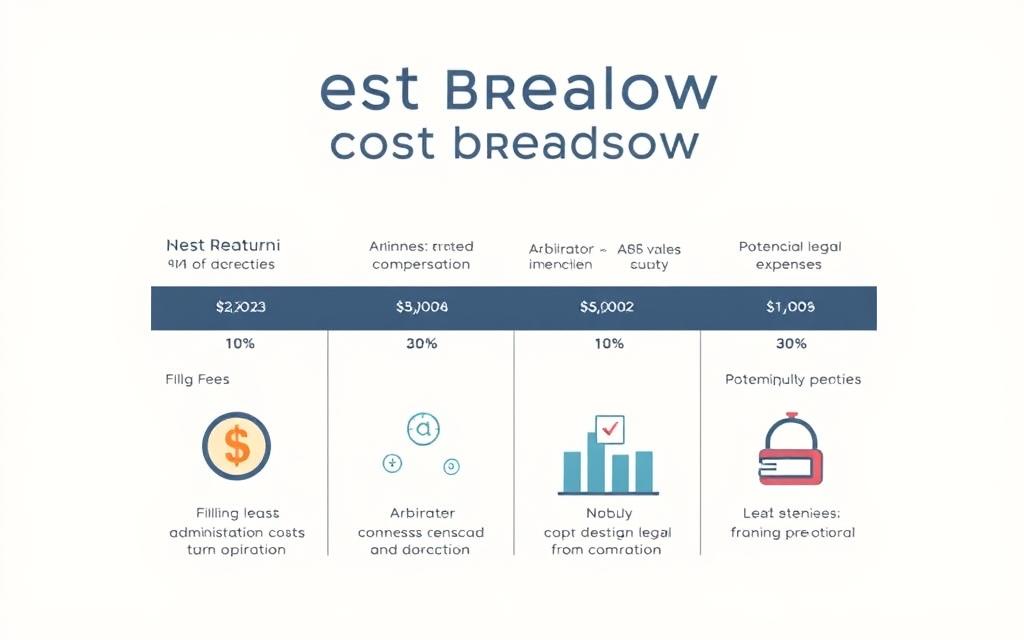
Understanding legal hearing arbitration costs is key. These costs can change a lot based on several important factors. It’s vital to think about these before starting.
The Arbitration Procedure Guide talks about main costs for dispute solving:
- Arbitrator fees and compensation
- Administrative expenses
- Legal representation costs
- Hearing venue charges
- Documentation and evidence preparation
Breakdown of Arbitration Expenses
Arbitration costs include fees for neutral arbitrators. These fees can be $200 to $700 an hour. The case’s complexity affects these costs.
Simple cases might end fast. But complex ones could take days or weeks.
Factors Influencing Cost Structures
Many things affect arbitration costs:
- Case complexity – Complex cases need more time and skill
- Number of arbitrators involved
- Duration of the hearing process
- Geographic location of arbitration
- Required expert testimonies
Arbitration costs can be high. But they’re often more stable and cheaper than court. To save money, pick efficient arbitrators and keep clear communication.
Common Misconceptions about Arbitration
Arbitration often has many misunderstandings. These can make people see it in a bad light. Knowing how arbitration really works can help people make better choices.
Many people have wrong ideas about arbitration. Let’s look at some common myths.
Debunking Arbitration Myths
- Myth: Arbitration is always faster and cheaper than court litigation
Reality: Arbitration can be quicker and cheaper, but big cases can take a lot of time and money. The outcome depends on the case.
- Myth: Arbitration guarantees a favorable outcome
Reality: Arbitrators make their own decisions based on the facts. There’s no sure win. You need to prepare well.
- Myth: Arbitration decisions can always be appealed
Reality: You can’t appeal arbitration awards often. Arbitration is known for being final.
Understanding Arbitration Limitations
Arbitration has its own rules that everyone needs to know. It’s different from going to court because:
- Discovery is limited
- Appeals are rare
- Proceedings are private
To do well in arbitration, you need to know its limits and what it can offer.
The Benefits of Arbitration
Arbitration is a great choice instead of going to court. It has many good points for solving legal problems. Knowing the Arbitration Rules & Steps shows why many like it.
Arbitration has big advantages over going to court. It makes solving disputes easier and faster. What Happens At Arbitration shows its unique benefits for different legal issues.
Speed and Efficiency
Arbitration is much quicker than court cases. It has key points that make it fast:
- Faster scheduling of hearings
- Simplified procedural rules
- Reduced paperwork and legal formalities
- Quicker decision-making process
Confidentiality and Privacy
Arbitration keeps things private, unlike court. It offers:
- Closed-door discussions
- Limited public record of proceedings
- Protection of sensitive business information
- Reduced risk of reputational damage
It lets businesses and people solve problems quietly. This keeps professional relationships strong and protects important info.
Disadvantages of Arbitration
Arbitration has its good points, but it also has big downsides. The Arbitration Outcome Guide shows key challenges that can make the process unfair or not work well.
Knowing the limits of arbitration helps people and companies make smart choices about solving disputes.
Limited Appeal Options
Arbitration has a big problem: very few chances to appeal. Unlike regular court cases, arbitration decisions are hard to change legally. They are usually:
- Hard to legally challenge
- Final with few review chances
- Almost never changed by courts
Unequal Bargaining Power Risks
Arbitration can lead to big unfairness, mainly for consumers and workers. Big companies often make arbitration deals that hurt people more.
| Potential Disadvantage | Impact on Participants |
|---|---|
| Restricted Discovery | Can’t gather much evidence |
| Higher Upfront Costs | Can cost a lot of money |
| Potential Arbitrator Bias | Can feel unfair |
People should look closely at arbitration deals. They need to know the limits before agreeing to use this method to solve disputes.
Comparing Arbitration with Litigation
Understanding the differences between arbitration and litigation is key. Legal experts say each has its own benefits for solving disputes.
There are two main ways to solve legal problems: arbitration and traditional lawsuits. Each has its own special features that can change the outcome of a case.
Key Differences in Dispute Resolution
Looking at arbitration vs litigation, we find some big differences:
- Time Efficiency: Arbitration usually solves problems quicker
- Cost Considerations: Arbitration is often cheaper
- Privacy Levels: Arbitration keeps things private
- Flexibility in Process: Arbitration lets you set up hearings in different ways
When to Choose Arbitration
Choosing arbitration is important. It’s good for certain situations. Here are some examples:
- Complex business disputes
- International business issues
- Disagreements in employment contracts
- Needs for special industry knowledge
It’s important to think about your situation carefully. Talking to legal experts can help you make the best choice.
Conclusion
Understanding arbitration hearings is key to solving disputes. Arbitration is a smart choice instead of going to court. It helps businesses and people solve legal problems quickly and easily.
Getting ready for arbitration needs careful planning and expert help. At The Bill Connor Law Firm, we know how arbitration works. We help our clients keep their rights safe.
Technology is changing how we do arbitration. Now, it’s easier to join hearings online and share documents. Choosing the right lawyer is more important than ever.
Arbitration is a good way to solve big legal problems. With the right advice, it can be a cost-effective solution. It helps keep your interests safe during the process.
About the Author