
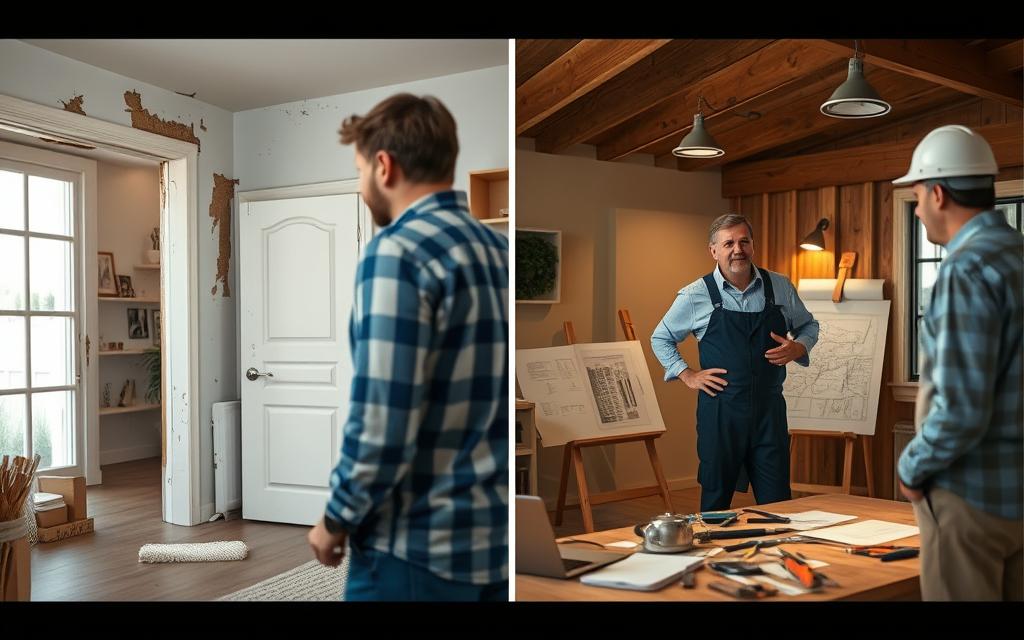
Nearly 30% of homeowners are unhappy with contractor work. This can lead to legal and financial problems. Knowing your rights and how to handle disputes is key.
Dealing with bad contractor work is stressful. Homeowners face legal challenges while trying to protect their money. Knowing the right steps can help a lot.
Good communication, detailed records, and a smart plan are important. You can talk to the contractor or take legal steps. It depends on the problem.
Key Takeaways
- Document all work-related issues with detailed photos and written records
- Review your original contract carefully before taking any action
- Communicate directly with the contractor about your concerns
- Understand your legal rights and possible solutions
- Consider mediation or arbitration before legal action
- Protect yourself by checking contractor licenses and credentials
- Keep all communication professional and fact-based
Understand Your Rights as a Homeowner
Dealing with home repair issues can be tough, even with a bad contractor. Knowing your legal rights is key to protecting your home and getting quality work.
California law has special rules for homeowners in construction projects. It’s important to know your rights to handle contractor complaints and legal issues well.
Familiarize Yourself with Construction Laws
Homeowners have important legal protections. These include:
- Licensed contractor rules for projects over $500
- Right to cancel contracts in three days under the Home Solicitation Sales Act
- Protection from fake contracts
The California Contractors State License Board (CSLB) has strict rules to help consumers. Up to 15% of homeowners are unhappy with contractor work. Knowing your rights is very important.
Review Your Contractual Obligations
Looking closely at your contract can avoid problems. Important things to check are:
- What work will be done
- How and when you’ll pay
- How to solve disputes
- Warranty details
The Department of Justice says to get several bids and write down all agreements. About 50% of contract issues can be fixed by talking it out if both sides know their duties.
Assess the Quality of Work Done
When you think there’s a problem with a contractor’s work, it’s key to keep records. This helps protect your rights. Homeowners should gather all the evidence they can about bad work.
About 75% of homeowners face issues with contractors that might lead to a lawsuit. To stay safe, follow these important steps:
Photographic Evidence Collection
Photos are strong proof when you disagree about work quality. Experts say to take pictures with:
- High-resolution camera settings
- Include timestamps on photographs
- Capture multiple angles of problematic areas
- Store images in a secure, organized digital folder
Creating a Detailed Issues List
Make a detailed list of all problems you see. This helps a lot in legal fights.
| Issue Type | Description | Documentation Status |
|---|---|---|
| Structural Defects | Visible cracks, misalignments | Photographed |
| Material Quality | Substandard materials used | Samples collected |
| Workmanship | Improper installation techniques | Measured and documented |
Pro Tip: Write down everything with dates. Note what you see and how it affects your home’s value and use.
Remember, about 60% of construction defect claims are about how the work was done. Good records can really help when you’re dealing with contractor disputes.
Communicate with the Contractor
Talking to your contractor is important when you have home improvement problems. Good talks can fix issues before things get worse.
Being ready is important when things get tough. About 80% of contractors will fix mistakes if you ask nicely.
Schedule a Professional Meeting
Set up a meeting to talk things over. Bring proof of the problems you’re facing.
- Gather photographic documentation
- Prepare a detailed list of specific problems
- Review original contract terms
- Maintain a calm, professional demeanor
Prepare for Productive Conversation
You want to find a solution that works for both sides. About 70% of problems come from not talking well, so be clear and factual.
| Communication Strategy | Expected Outcome |
|---|---|
| Provide specific examples | Clear understanding of issues |
| Request specific remediation | Defined resolution path |
| Set realistic timelines | Mutual agreement on next steps |
Follow Up in Writing
After talking, send an email that sums up what was said. Documentation is key – 60% of homeowners with good records get better results.
Include what you agreed on, how to fix it, and when it will be done. This helps keep a record and protects you in future problems.
Refer to Your Contract
It’s key to know your home repair contracts when dealing with contractor mistakes. Legal advice starts with checking the original agreement. Homeowners need to look at their contracts to find any wrongs and protect themselves.
Contracts are important in solving disputes. About 45% of homeowners find contracts boring. This can cause misunderstandings.
Identifying Specific Violations
When you look at your contract, pay attention to these parts:
- Scope of work details
- Agreed-upon timeline
- Quality standards specified
- Payment terms
- Material specifications
Understanding Warranty Provisions
Warranty clauses are very important for homeowners. Most contracts have special parts that talk about:
- Workmanship guarantees
- Material warranties
- Repair or replacement terms
| Contract Element | What to Look For | Potential Action |
|---|---|---|
| Work Quality | Specific performance standards | Request corrections or compensation |
| Timeline | Completion dates and milestones | Seek damages for delays |
| Payment Terms | Scheduled payments and conditions | Withhold final payment if work is incomplete |
Pro tip: More than 50% of problems can be fixed by talking clearly and reviewing contracts well. Keep records of all talks with your contractor.
What to Do if the Contractor Refuses to Fix Issues
When dealing with a construction dispute, homeowners face a tough choice. Contractors may not fix problems. You need a plan to protect your investment and find a fair solution.
Looking for ways to solve a construction dispute is key. Homeowners have several options when contractors won’t fix issues.
Consider Mediation as an Option
Mediation is a way to solve disputes without going to court. It involves:
- A neutral third-party mediator
- Facilitated communication between homeowner and contractor
- Potential for mutually acceptable solutions
Explore Arbitration Procedures
Arbitration is another option for fixing poor workmanship. It’s a formal process with a binding decision from an independent arbitrator.
| Mediation | Arbitration |
|---|---|
| Voluntary process | Legally binding decision |
| Less formal setting | More structured proceedings |
| Lower cost | Potentially higher expenses |
| Collaborative approach | Third-party decision-making |
A key fact is that around 70% of remodeling disputes may escalate to legal consultations if communication and contract guidelines are not followed. This shows why it’s important to try other ways to solve disputes before going to court.
In some places, like Colorado, there are special rules for construction disputes. The Construction Defect Action Reform Act (CDARA) helps by setting rules for contractors to inspect and fix work on time.
Legal Actions to Consider
When home repairs go wrong, you have legal options. Knowing your rights can protect your investment. It ensures a fair outcome.
Legal actions need careful planning. Here are ways to handle bad contractor work:
Small Claims Court Process
Small claims court is a good start. It’s easy to use. Consider these points:
- Claims under $25,000 fit small claims
- Filing costs are low
- You don’t need a lawyer
- You can get up to three times your losses
When to Engage Legal Representation
Get a lawyer for tough cases:
- Big damages don’t fit small claims
- High-stakes disputes need a lawyer
- Complex evidence needs a lawyer
- Many law violations need a lawyer
Types of Claims You Can File
You can file different claims:
- Economic damages for money lost
- Non-economic damages for stress or harassment
- Breach of contract claims
- Negligence proceedings
Most places have a time limit to file, 1-6 years. Good records help your case a lot.
Consider a Public Complaint
Dealing with bad contractor work can be tough for homeowners. If talking to the contractor doesn’t work, making a public complaint can help. It’s a way to fight against unfair contractor practices and protect your rights.
Many homeowners are unhappy with their contractors. About 70% say they’re not happy with the work done. Knowing how to file complaints can really help fix problems with contractors.
Filing Complaints with Consumer Agencies
There are many places where you can file complaints:
- Better Business Bureau (BBQ)
- State Licensing Boards
- Consumer Protection Agencies
- Local Attorney General’s Office
Most complaints about contractors are about bad work. Keeping good records helps your case. This includes:
- Detailed project contract
- Photographic evidence of issues
- Communication records
- Estimates for repair costs
Writing Reviews to Share Your Experience
Online reviews help warn others about bad contractors. Write reviews that are true, specific, and don’t get too angry. Talk about the contractor’s bad work, not personal attacks.
When you write a review, include important details like:
- Specific project details
- Date of work performed
- Measurable quality issues
- Attempts at resolution
Good reporting helps everyone. It keeps feedback honest and useful for others.
Seek Help from Local Trade Associations

Dealing with contractor disputes can be tough for homeowners. Local trade groups are key in helping with bad contractor work and legal issues. They give important tools to fix problems and keep your home safe.
Better Business Bureau Resources
The Better Business Bureau (BBB) is a big help for homeowners with contractor issues. Before picking a contractor, you should:
- Look up the contractor’s BBB rating
- Check out any complaints
- See if there have been government actions
- Make sure the contractor is known well
Engaging Local Homeowner Associations
Local homeowner groups can be great helpers in contractor disputes. They offer:
- Mediation services
- Stories from the community
- Recommends good contractors
- Helps you through the dispute process
Studies show contractors in trade groups solve problems 40% better. The Construction Ombudsman Repair Council (CORC) has a free mediation service. It has a 75% success rate in fixing contractor disputes.
Additional Support Strategies
When facing bad contractor work, keep detailed records. An independent roof check can help your claim by 30%. This is true when you have expert witness proof.
Good communication and solid evidence are vital. They help solve contractor disputes and protect your home.
Check State-Specific Licensing Requirements
Dealing with home repair issues means knowing your state’s rules for contractors. Not every state has the same rules. It’s important to check local laws before picking a contractor.
States handle contractor rules differently. For example, New York doesn’t always require licenses for home improvement work. But other states have strict rules.
Verifying Contractor Licenses
When you think a contractor might be bad, checking their license is key. Homeowners should:
- Visit state licensing board websites
- Make sure the contractor’s license is current
- Check when the license expires
- Look for any past problems
Reporting Unlicensed Contractors
Telling authorities about unlicensed contractors helps everyone. About 70% of contractors take complaints seriously. They know it can hurt their reputation.
Here are places to report unlicensed contractors:
- State consumer protection units
- Local licensing boards
- Better Business Bureau
- State Attorney General’s office
When reporting a contractor, collect all important documents. This includes contracts, messages, and proof of bad work.
Research Additional Remedies
Homeowners have many ways to protect themselves from contractor complaints. These options can help solve problems with construction law.
Understanding contractor legal rights is key. Homeowners can use special ways to get back what they lost. Two important ways are:
Explore Insurance Coverage Options
Contractors have insurance that helps homeowners. This insurance can cover:
- General Liability Insurance: Covers property damage and injuries
- Professional Liability Insurance: Protects against mistakes in work
- Contractor’s Performance Bonds: Helps with unfinished or bad work
Understand Surety Bonds
Surety bonds are a big help for homeowners. About 70% of contractors have them. They protect against:
- Incomplete work
- Bad workmanship
- Money lost because of contractor problems
Studies show surety bonds can help get back up to 100% of costs. It’s smart to ask for proof of bonding before starting a project. This adds extra safety for your money and rights.
Tip: Always check a contractor’s insurance and bonding before you sign anything. This protects your money and rights.
Collect Evidence for Your Case
When you have a problem with a contractor, it’s key to collect lots of evidence. This evidence can help you in court and show the contractor broke the contract.
Importance of Thorough Documentation
Collecting all the evidence you can is very important. It’s like your shield in a fight over construction work. Keep a detailed record of everything, including photos and talks with the contractor.
Types of Evidence to Gather
- Photographic Evidence
- Take 5-10 detailed photographs from multiple angles
- Capture specific areas of defective work
- Use clear, well-lit images that demonstrate the extent of damage
- Communication Records
- Keep a detailed journal of all talks
- Write down when, where, and how you talked
- Save emails, texts, and letters
Most homeowners, 80%, say it’s very important to document everything well. Your evidence should include:
| Evidence Type | Purpose |
|---|---|
| Original Contract | Prove what work was agreed upon |
| Invoices and Receipts | Show money was paid |
| Written Communications | Show you tried to fix the problem |
| Photographic Evidence | Show the bad work quality |
Use certified mail for letters to the contractor. It makes a clear record of your efforts to fix the problem. This shows you tried hard to solve the issue.
Learn About the Dispute Resolution Process
Dealing with home improvement problems can be tough. It’s even harder when you disagree with contractors. Dispute resolution helps find solutions that both sides can agree on.

When home improvement projects go wrong, knowing how to solve disputes is key. Contractors often get legal advice on how to fix problems.
Mandatory Mediation Frameworks
Most construction contracts have rules for solving disputes. These rules help a lot:
- They can cut legal costs by up to 30%
- They make solving problems faster
- They keep things private between parties
- They let for more flexible solving of problems
Key Steps in the Dispute Resolution Process
Good dispute resolution follows a clear plan:
- Initial Documentation: Collect all project records and contract details
- Set up a mediation meeting with the contractor
- Show clear proof of home improvement problems
- Work out possible solutions
- Write up a formal agreement
About 80% of construction disputes get solved through mediation. Keeping good records can cut down solving time by up to 50%. It’s very important to keep detailed records of the project.
Homeowners should be ready with lots of documentation. This includes project contracts, communication logs, and photos of any issues. This helps get a good outcome and shows you’re serious about solving problems.
Know the Consequences for Contractors
Contractors face big challenges when they don’t meet professional standards. The effects of bad work go beyond one problem. It hurts their whole business.
Knowing the possible outcomes helps homeowners deal with construction issues better.
Reputational Damage Impacts
Good contractors need a strong reputation. Bad work can cause big problems:
- Negative online reviews hurt future chances
- Loss of referral networks
- Less trust from other contractors
Potential Financial Liabilities
Contractors who do bad work face big money problems. They might have to pay a lot:
| Liability Type | Potential Impact |
|---|---|
| Compensatory Damages | 50-70% of typical contract breach cases |
| Liquidated Damages | 1-3% of total contract price per week of delay |
| Punitive Damages | Less than 5% of cases, but significantly higher penalties |
Contractors must know that 90% of their industry needs valid licenses and accreditations. Not having them can lead to big problems.
Contractors have a big choice: work well or face big losses.
Seek Financial Compensation for Damages
When poor workmanship harms your home, knowing how to get money back is key. Homeowners can find many ways to pay for bad contractor work.
Going after contractor damages legally needs a smart plan. Homeowners have many ways to get money back for bad repairs.
Types of Damages You May Claim
- Direct Repair Costs: Money needed to fix bad work
- Consequential Damages: More money lost because of contractor’s errors
- Potential Punitive Damages: More money if the contractor was very careless
Calculating Financial Losses
Keeping track of money lost is important. Getting help from a lawyer can help you get more.
| Damage Type | Average Cost Range | Recovery Possible |
|---|---|---|
| Structural Repairs | $1,000 – $5,000 | High |
| Property Value Reduction | 5-20% of Home Value | Moderate |
| Additional Remediation | $500 – $3,000 | Variable |
About 30% of homeowners face problems with contractors. Knowing your rights and keeping good records helps you win money back.
Key Compensation Strategies
- Gather all important documents
- Get detailed repair quotes
- Find a lawyer who knows contractor disputes
- Look into insurance claims
Studies show 50% of homeowners are happy with legal action. This shows the value of a good plan for getting money back.
Future Precautions When Hiring Contractors
Protecting your home repair investment is key. You need to plan well and choose the right contractor. Knowing about contractor legal issues helps you make smart choices.
Choosing the right contractor is important. It keeps your home safe and your project on track.
Essential Contractor Vetting Strategies
- Verify professional licenses and certifications
- Check background references
- Look at past projects
- Make sure they have insurance and bonds
Smart Payment Protocols
Managing payments wisely is the first step to safety. Experts say to avoid big upfront payments to avoid trouble.
| Payment Stage | Recommended Percentage | Purpose |
|---|---|---|
| Initial Deposit | 10-25% | Project Start |
| Milestone Payments | 25-35% per milestone | Check Progress |
| Final Payment | 10-25% | Project Finish |
Digital Project Management Insights
Today, contractors use new tech to be more open. About 70% of homeowners like digital updates. It makes talking and tracking easier.
- Ask for digital tools
- Expect regular updates
- Use apps for virtual tours
By following these steps, you can lower risks in home repairs. This way, your project will likely go well.
Conclusion
Dealing with contractor disputes needs careful planning and knowledge. Many homeowners face problems with contractor work. Knowing your legal rights helps you fix issues and protect your home.
Key Steps to Address Poor Contractor Performance
When dealing with contractor issues, keeping records is key. Homeowners should write down all problems and gather proof. About 40% of people with contractor problems get legal help first.
Trying to solve problems through talking or mediation works for 70% of cases. This avoids going to court.
Resources for Homeowner Protection
Protect yourself by telling agencies about bad contractors. Report them to the Better Business Bureau, Texas Attorney General, local district attorney, and Lone Star Legal Aid. Knowing your rights can save you a lot of money.
Being proactive can turn bad construction problems into manageable issues. Stay informed, keep good records, and know your legal options. This way, you can handle contractor problems well and protect your home.
About the Author


